Historical Background:
On April 24, 1879, Emperor Franz Joseph I. and his wife Elisabeth celebrated their silver wedding anniversary. For this reason, a parade was held from the Prater over the Aspern Bridge to the Ringstraße.
Hans Makart, professor at the Special School for History Painting, was commissioned to design this parade. This procession also included floats dedicated to hunting.
Josef Schantl, solo horn player of the K.u.K. Court Opera, was commissioned to arrange hunting music for the two hunting floats. Since four-part hunting fanfares were not yet known at that time, Josef Schantl composed the required fanfares for the Dampier horns in E♭ that were used then. In this quartet, alongside Josef Schantl, were Anton Wunderer, Emil Wipperich, and Franz Pichler, all members of the K.u.K. Court Opera (today the Vienna State Opera).
The Gründerzeit Era:
Inspired by the Makart parade and the great success of the quartet, the idea arose in 1883 to found the "First Vienna Hornists' Club" with Josef Schantl, a predecessor of the Wiener Waldhornverein (Vienna Waldhorn Association).
A founding member was, among others, Johannes BRAHMS, himself a horn player and a staunch advocate of the natural horn, who was also actively involved in the association.
This also marked the beginning of the golden era of original compositions for horn quartet and horn ensemble, in which Josef Schantl, but especially Anton Wunderer, made a great name for himself.

Josef Schantl: 1st row, 4th from the left; Johannes Brahms: 2nd row, 4th from the left
The Early Years:
Although the "Erste Wiener Hornistenclub" (First Vienna Hornists' Club) was initially founded "for the purpose of socializing and cultivating the natural horn", it soon became clear that musical quality was also essential for the continued existence of the association in Vienna at the end of the 19th and beginning of the 20th centuries, alongside other numerous ensembles such as the Vienna Philharmonic or the Johann Strauss Orchestra.
At that time, as today, the association consisted of professional horn players, students, and amateurs. In order to bring all members to the same high level, Josef Schantl, who had been a professor at the Vienna Conservatory since 1883 (today the University of Music and Performing Arts Vienna – Konservatorium Wien Privatuniversität), wrote a four-volume horn method, which remains an integral part of horn training to this day, not only in Vienna.
In the years leading up to the First World War, countless concerts were given, which were met with great acclaim by both audiences and critics.
“Two rehearsal evenings” were held per week, and the number of members steadily increased. Only the outbreak of the First World War interrupted the association’s activities. After the end of the war, the work of the association, which had by then been renamed several times, was resumed.
The Interwar Period and the Second World War:
During these undoubtedly very difficult years, a small concert tour even took place, along with a few other concerts. Otherwise, the club's concert activities were likely mainly limited to performing the traditional St. Hubertus Mass in the Lainzer Tiergarten, as no reports of concerts from this period (unlike in previous years) can be found.
The political circumstances from 1935 onwards increasingly complicated the club’s work. The association’s name also had to be changed once again to comply with the emerging political turmoil under duress.
It is solely thanks to the relentless and strong determination of Hofrat Ing. Karl Hugo Pusch and Rudolf Huber that the association was able to continue to exist until spring 1945, despite the “Führer decree” ordering the dissolution of all associations.
The fact that (probably) Richard Wagner referred to the horn as “the most German of all instruments” was also likely one reason for its toleration, and the association received funding from the Reichsgau Vienna.
The musical activities of the association were limited to funerals for colleagues who had fallen in the war and small commemorative ceremonies among the members.
Only when the association’s premises were destroyed by a bomb in spring 1945, and the entire sheet music archive and historical instruments were buried under the rubble, did the association’s activities have to be suspended.
The Post-War Period, Like a Phoenix Rising from the Ashes:
When the first members returned home after the end of the war, they set out to dig sheet music and instruments out of the rubble. By 1946, rehearsals could be resumed under extremely difficult circumstances. In 1951, new statutes were drafted, and the name was changed to Wiener Waldhornverein. The following years were marked by a clear upswing, also because more professional horn players rejoined the association. The club’s archive recorded a lively concert activity. Highlights of this period included several radio concerts (ORF) and the first record recording in 1969 in collaboration with Decca (for insiders, it was a Black Decca production).
Another highlight was the participation in the 1st International Brass Congress 1976 in Montreux, which was organized, among others, by the International Horn Society. The WWV concert attracted great attention and lively media interest, even among the internationally represented horn community.
At that time, the WWV Publishing House was also founded in order to make the association’s now impressive sheet music archive accessible to the public.
In 1983, for the 100th anniversary, the WWV, under the presidency of Dr. Siegfried Schwarzl (Vienna State Opera), organized a horn symposium at the Vienna Konzerthaus under the patronage of the then Mayor of Vienna, Dr. Helmut Zilk. In addition to Dr. Schwarzl, Erhard Seyfried (RSO Vienna, long-time musical director of the WWV, composer) in particular made significant contributions to the association during this period. On the occasion of this anniversary, a second record was produced, which was presented by Karl Löbl (ORF Culture) as a “musical rarity”. The symposium was a resounding success and received both national and international attention. In the following years, the association remained active, producing further records and participating in international horn conferences (e.g., Munich, Innsbruck…).
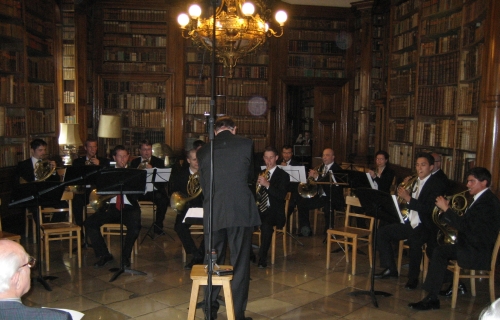
Wiener Waldhornverein at the Theresianum Vienna, April 2007
The Wiener Waldhornverein today:
With its now 130-year history, the WWV is the oldest association of horn players worldwide. (For comparison, the International Horn Society was founded in 1970). In recent years, the association has undergone a rejuvenation, which has again impacted the quality of the ensemble. Most active members today are students at Vienna’s music universities and schools, professional musicians from nearly all major Viennese orchestras, and, in accordance with the old tradition, hobby and amateur horn players.
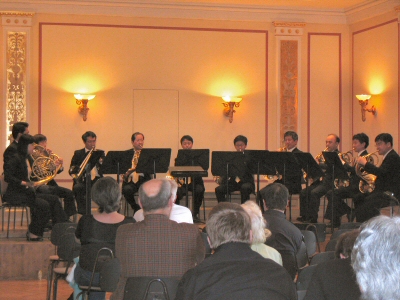
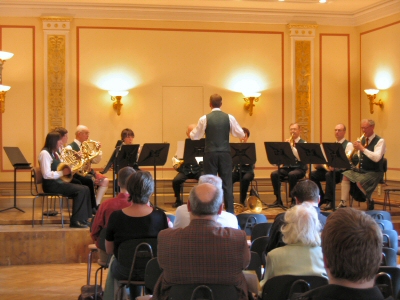
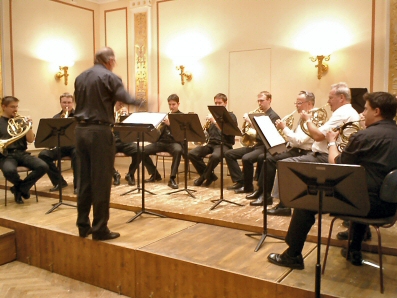
Highlights of recent years included joint concerts with the Tokyo Wienerhorn Association and the Scottish Vienna Horns at the Musikverein Vienna, a gala concert for the 20th anniversary of the Japanese-German Horn Club in the old Library Hall of the Theresianum Vienna, a performance in the Great Hall of the Vienna Konzerthaus, concerts in the Schubert Church Vienna, and a concert against the impressive backdrop of Rein Abbey.
 |
|
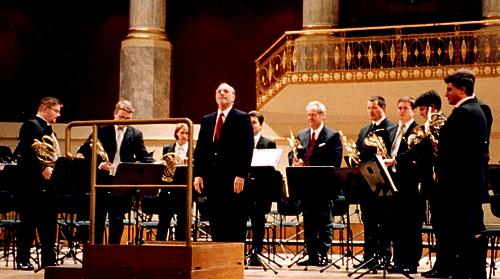
WWV in the Great Hall of the Vienna Konzerthaus |
 |
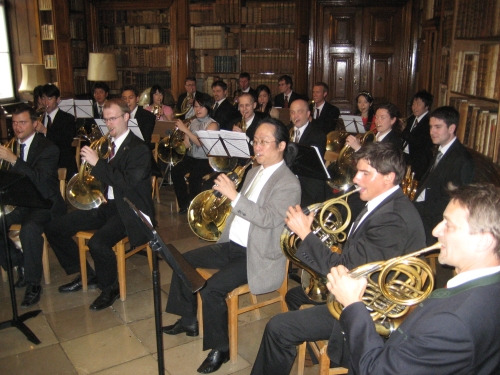 |
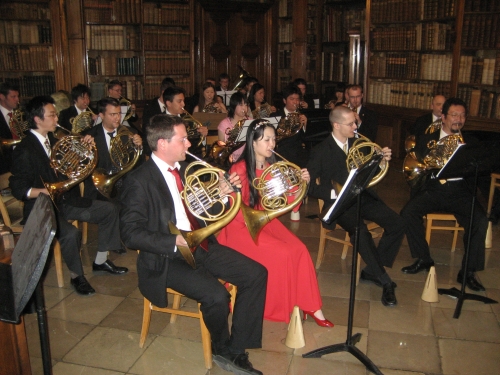
Japanese-German Horn Club & Wiener Waldhornverein at the Theresianum, April 2007

Concert at Rein Abbey, June 2007
The three associations together in the Gottfried von Einem Hall at the Musikverein Vienna
 |
 |
| Tokio Wiener Horn Verein | Scottish Vienna Horns |
 |
 |
An, exceptionally, non-musical innovation took place in 2005, when the association was expanded to include a football team, the FC WWV.
All information about the FC WWV can be found here.